Embedded ledger infrastructure without the platform weight.
Blocks, transactions, peer state, governance, and SQL-readable world state stay close to the application instead of becoming a separate operations program.
Built for private ledgers that need to ship
MiniLedger gives engineering teams the control model of a private blockchain with the deployment shape of a normal Node.js dependency.
Application teams
- Embed the ledger in a service
- Keep data local and inspectable
- Avoid a new infrastructure platform
Enterprise workflows
- Audit trails
- Supply chain provenance
- Compliance evidence
Consortium pilots
- Multi-party shared state
- Peer-to-peer synchronization
- Governance from day one
Why teams choose MiniLedger
A lightweight alternative to Hyperledger Fabric, R3 Corda, and Quorum for teams that need a private blockchain without the operational burden.
No platform ceremony
No Docker, Kubernetes, certificate authorities, orderer services, or separate ledger runtime to operate.
Queryable ledger state
World state lives in SQLite, so product teams can inspect ledger data with ordinary SQL instead of custom query APIs.
Embeddable by default
Import MiniLedger into a Node.js or TypeScript service and ship a ledger as part of the application.
Enterprise-grade primitives, Node-native shape
The core primitives are built in, but exposed in a way that feels familiar to product engineers.
Raft consensus
Leader election, log replication, and fault tolerance across multi-node private clusters.
JavaScript contracts
Deploy plain JavaScript functions that read and write ledger state without Solidity, Go, or Kotlin.
Per-record privacy
AES-256-GCM field encryption with ACL-based access control, without channel sprawl.
On-chain governance
Propose, vote, and execute network changes through quorum-based governance flows.
Explorer included
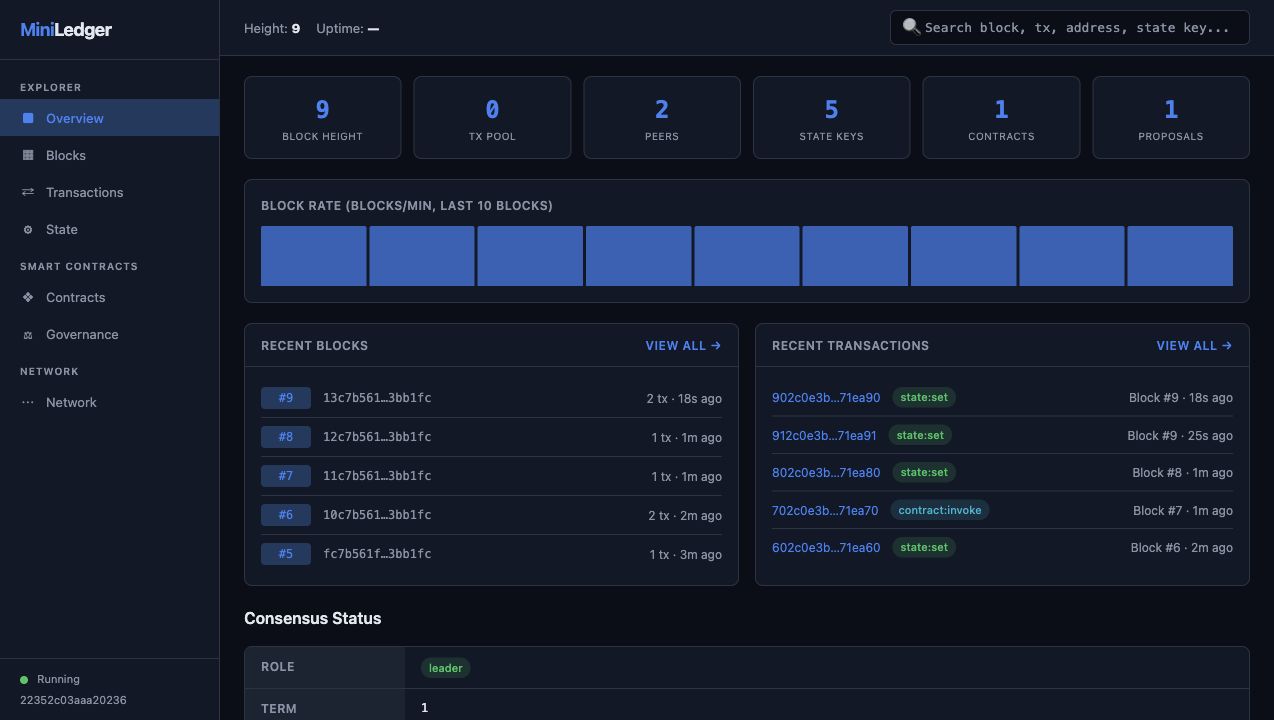
Use the dashboard for blocks, transactions, state browsing, SQL console, and full-text search.
P2P networking
Run a WebSocket mesh with peer discovery, reconnection, and chain synchronization.
A private ledger that fits inside your stack
MiniLedger keeps the blockchain primitives explicit while removing the infrastructure layer that makes most enterprise ledgers slow to adopt.
- Every write is signed, hashed, and committed to a block.
- Peers replicate through WebSocket mesh networking.
- State remains inspectable through SQL and the built-in explorer.
From install to queryable ledger state
Start a private ledger, submit signed transactions, and inspect state with SQL from the same application runtime.
import { MiniLedger } from 'miniledger';

const node = await MiniLedger.create({ dataDir: './my-ledger' });
await node.init();
await node.start();

// Submit a transaction
await node.submit({ key: 'account:alice', value: { balance: 1000 } });

// Query state with SQL
const results = await node.query(
  'SELECT * FROM world_state WHERE key LIKE ?',
  ['account:%']
);
SELECT key, value FROM world_state;| Key | Version | Value |
|---|---|---|
| account:alice | 9 | { balance: 1000 } |
| account:bob | 9 | { balance: 725 } |
| shipment:7f2 | 8 | { status: "cleared" } |
How it compares
MiniLedger is designed for teams that want a private ledger without adopting a full blockchain operations platform.
| MiniLedger | Hyperledger Fabric | R3 Corda | Quorum | |
|---|---|---|---|---|
| Setup time | 10 seconds | Hours/days | Hours | Hours |
| Dependencies | npm install | Docker, K8s, CAs | JVM, Corda node | JVM, Go-Ethereum |
| Config files | 0 (auto) | Dozens of YAML | Multiple configs | Genesis + static nodes |
| Consensus | Raft (built-in) | Raft (separate orderer) | Notary service | IBFT / Raft |
| Smart contracts | JavaScript | Go / Java / Node | Kotlin / Java | Solidity |
| State queries | SQL | CouchDB queries | JPA / Vault | No native query |
| Privacy | Per-record ACLs | Channels (complex) | Point-to-point | Private transactions |
| Governance | On-chain voting | Off-chain manual | Off-chain | Off-chain |
| Dashboard | Built-in explorer | None (3rd party) | None | None |
| Embeddable | Yes (npm library) | No | No | No |
Built for real enterprise workflows
Use MiniLedger when a normal database is not enough because multiple parties need a shared, signed, replayable history.
Audit and compliance trails
Tamper-evident records for regulated workflows, financial controls, healthcare activity, and internal approvals.
Supply chain provenance
Track goods, documents, custody, and state changes across organizations with cryptographic verification.
SaaS tenant ledgers
Embed immutable histories, account movements, credits, loyalty points, or workflow state inside a product.
Multi-party operations
Run peer nodes across teams, partners, or subsidiaries while preserving local control and shared consensus.
Start with a ledger your team can understand
Install MiniLedger, run a node locally, and scale into a private multi-party network when the workflow is ready.
npm install miniledger